Alice Dote Brazil, b. 1992
-
 café da manhã (breakfast), 2025
 -
beijos banhos e beats (kisses showers and beats), 2026
-
o que você sabe sobre liquidificadores (what do you know about blenders), 2026
-
ele dizia que eu era uma das únicas que (he used to say I was one of the only ones to), 2025
-
na cidade onde reaprendi a salivar em público (in the city where I relearnt to salivate in public), 2025
-
é como deixar acumular para mais tarde, almoçando pensando na sobremesa (it's like letting it accumulate for later, having main course thinking of dessert), 2025
-
icaraízinho de amontada, uma âncora (icaraízinho de amontada, an anchor), 2025
-
icaraízinho de amontada, o dia seguinte (icaraízinho de amontada, the day after), 2025
-
verão paulistano (São Paulo summer) , 2025
-
na casa catalã (in the catalan house), 2024
-
no tirar disolvente em el baño (do not pour solvent down the toilet), 2024
-
ovos e outros objetos sólidos (eggs and other solid objects), 2024
-
pêras alecrim alho e limão para a ceia (pears rosemary and lime for dinner), 2024




Emerging painter from Ceará, Northeastern Brazil.
Last year, I visited Alice Dote in her studio in Fortaleza, Brazil, and watched with fascination at the explosion of press, energy and events that exploded when her first institutional solo exhibition launched in October 2025 at the Centro Cultural Banco do Nordeste.
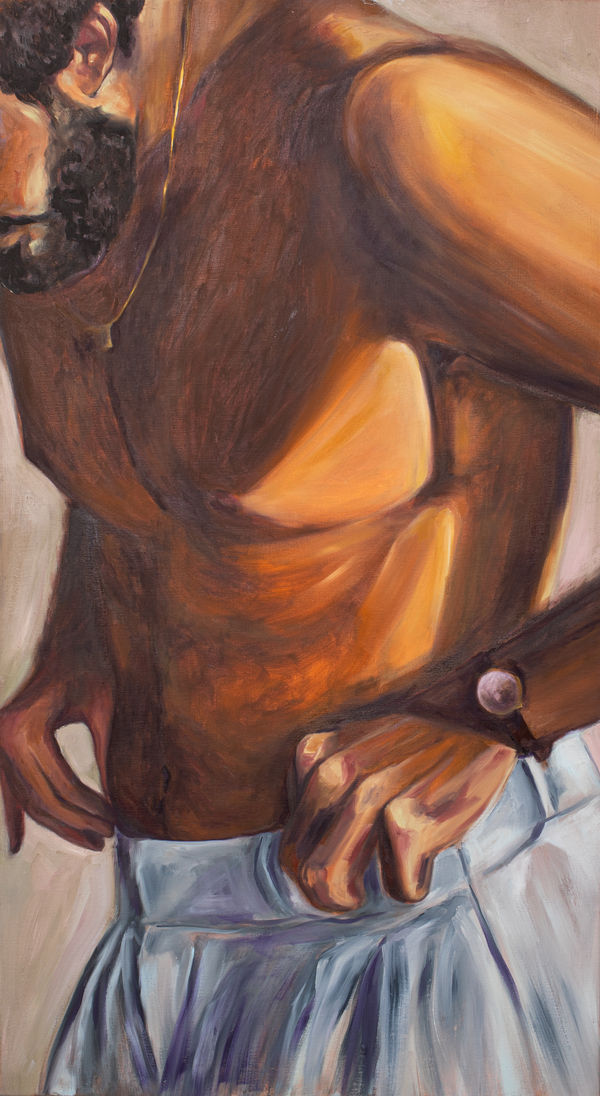
Alice’s work is courageous and audacious, using an autobiographical lens to explore sensuality, libido and hunger from a female perspective. Her work explores the often melancholy and transience of desire (s), and has an original engagement with Freud’s theory of Eros and Thanatos (desire vs destruction) and the dynamic, creative force that arises when these two forces continue their eternal push-and-pull in every human heart. She investigates the fields of eroticism and sexuality, memory and grief, which converge in an interest in intimacy of images, including cell phone images of intimate encounters or their immediate aftermath. Her research operates within the tension of a sexual politics of the gaze, in the proposition of eroticism as a procedure, and in the transductions between the intimate and the public.
For such a young artist, Alice uses oil paint with a skill, hunger and sensuality that bodes well for her future development. At a time when north-eastern Brazil (historically ignored and underestimated within Brazil itself) is becoming a major economic and cultural force, as well as the aesthetics of Latin America receiving unprecedented attention worldwide, this feels the perfect time for the works of Alice Dote to make their debut in an international context.

Dote's artistic training has been largely independent, and includes institutions in Fortaleza, São Paulo, and Barcelona, such as the Tomie Ohtake Institute, Ateliê Piratininga, Barcelona Academy of Arts, and Cultural Hub of Porto Dragão.
In 2025, she was a resident of the PRIS Residency and Exchange Program at Cultural Hub Porto Dragão, Ceará. She participated in the Pivô 2025 Annual Auction and this same year, she launched her first institutional solo exhibition 'O Nome Disso Não é Fome' (The Name of This isn't Hunger) at Banco do Nordeste Cultural, Fortaleza. In 2026, she was granted her first monograph by the Rio-de-Janeiro based publisher Barleu, accompanied by a solo show at Rato gallery, Rio de Janeiro.
Recently, she has participated in group exhibitions in Fortaleza and São Paulo, at Sala de Arte do Canto (SP); Casa Gabriel Arte (SP); OMA Galeria (SP) and Galeria Leonardo Leal (CE). She participated in SP-Arte Rotas Brasileiras 2024 through Claraboia Gallery (SP).
She holds a Master's degree in Sociology from the Federal University of Ceará.