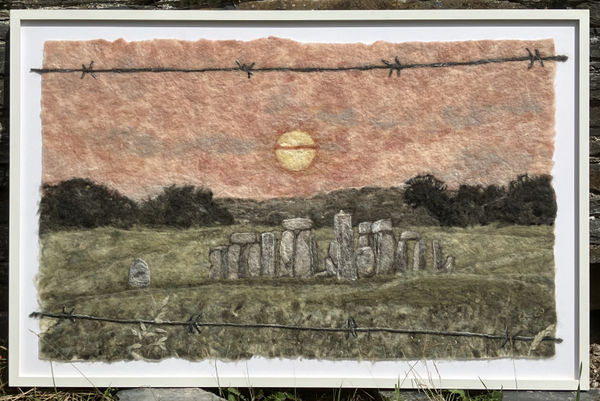
We are pleased to present Elizabeth-Jane Grose's new work in her ongoing series Living Landscapes (2024 - ) . Deeply rooted into the landscape of their making, and informed by the artist's experiences during the last 20 years of walking around the dramatic piece of Cornish coast surroundingRock and the Camel Estuary, these works are the culmination of a long, slow and embodied process of making that begins at her nearby smallholding in North Cornwall.
There, she grows the materials used to create the resulting responses to the landscape experienced in those walks. The wool, which forms the main material used in this series, comes from her small flock of rare breed sheep. Alongside cultivating the wool, she also grows the plants which she uses to create the dyes which colour these works; among them Woad, Nettle, Dandelion, Daffodil, Madder and other native plants.
Grose's landscapes, the result of a unique dedication to her raw materials, are constructed from wool layer upon layer, using ancient processes including spinning, carding, felting and dyeing to create surfaces which seem alive. Colours and textures ebb and flow, drawing the eye across the picture plane and generating depth, density and texture within the picture plane.
The complex inter-relationships which created our landscapes inhabit these works; millennia of humans, plants and animals living in fragile relationships which are constantly changing and today find themselves in unprecedented risk. In addition to this, Grose's 'craft-based' practice tends to be associated with domesticity and folk traditions, or assigned to the realm of so-called 'women's work'; work which has been widely eroded, derided and devalued during the last centuries.
Living Landscapes, created from peasant and gendered materials, therefore challenge these gender and class-based assumptions of artistic value, elevating the 'craft' element present in these works to the realm of contemporary art; urgent, alive and timely. The exhibition thus offers a contemporary reexamination of landscape from an artist whose practice acknowledges the current vulnerability of natural systems and the inherent political nature of the landscape. Elizabeth-Jane Grose also creates plant portraits of the flora she uses for her dyes and hand weaves soft rugs from her sheep's wool.
Her work has been exhibited widely, with previous exhibitions and collections including: the Eden Project Florilegium Archive; Das Urwort Museum at ACC Galerie Weimar; Earthly Delights for Ikon Touring; the Royal Society of Marine Artists at the Mall Galleries, London; and public commissions such as Birdsong, Legacy and Lining up the Ducks and Waders for Halton Borough Council's Wigg Island Visitors Centre, and River of Words for the Environment Agency. Most recently, she presented 'Contested Field'; an installation presented in the first edition of FLAMM contemporary art festival, Bodmin.
Grose studied Fine Art at Reading University and obtained an MA at Goldsmiths College, University of London.