‘Narcélio Grud is used the seeing the world around him as an environment to be transformed. Instead of conforming to the given social context, he prefers to think that a context is something waiting to be modified by his art interventions....as an artist, he is more interested in transforming the world than he is in depicting it’ (Baixo Ribeiro, 2023)
Narcélio Grud (b.1976, Fortaleza, Brazil) is an emerging figure in contemporary sculpture whose studio practice focuses on sculpture, objects and works on paper that incorporate kinetic, sonic and interactive elements. His works explore the extended plastic possibilities of steel and wood, often incorporating natural elements of light, wind and sound and are often also accompanied by an organic or spontaneous intervention that further enrich the possibilities of his concrete abstraction. Either by incorporating movement, sound or unusual plastic manipulation into sculptures made of materials traditionally seen as fixed or static, or by inviting the participation of the viewer, Grud’s work proposes new possibilities of connection with the world at large.
In Grud’s work, there finds a new and irreverent formalism - passed down from the Concrete and Neo-concrete movements that are so important in the evolution of contemporary Brazilian art – but brought vitally into the present moment by proposing abstraction as a force for transformation. His work often examines and provokes new perspectives of our current reality of climate change and the widespread degradation of nature – always in the spirit of hope, promise, improvisation and with a knowledge of the wild, limitless intelligence contained within us and within the materials and elements with which he works.
Anamorphysical presents new sculptural works that represent a new frontier in Grud’s practise. The title references this new frontier of distortion, extension or manipulation of materials; seeking the ephemeral in the midst of the intensely material. ‘Anamorphic’ is a concept usually linked to a fixed image that is formed as part of a process of distortion. The exhibition Anamorphysical instead seeks to arrive at a constantly-moving distortion; one that happens in the present moment and is linked to the infinite potential of movement within nature and the ability to evolve.
Leading the series are two works from the larger 'Perspective' series of 2024-5; kinetic steel sculptures with internal joints that can be hung or curled, stretched or contracted. These works have various perspectives; the viewer’s angle of vision can be changed, and the angles of the work itself can be changed. However, they work on a basic circular concept, inspired by Solar cycles. These works, as well as Serpentina, also shown here, have a strong visual and conceptual link with the seminal kinetic Bicho works by Lygia Clark. Clark’s Bichos allow manipulation of geometric steel forms through the use of hinges, but instead Grud uses steel with internal joints that are based on biomorphic structures in nature, such as in jointed grasses and other stalks, that allow infinite variety of movement and flexibility within an organised structure. Grud builds these works using numerations and ratios that exist with the Golden Ratio, aligning them with natural geometries that inherently exist in natural forms.
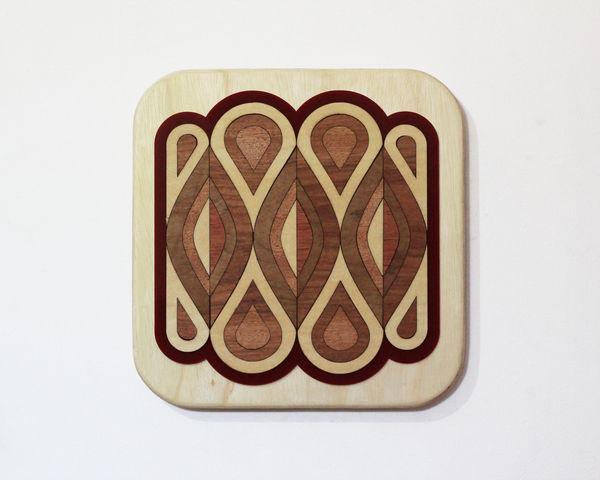
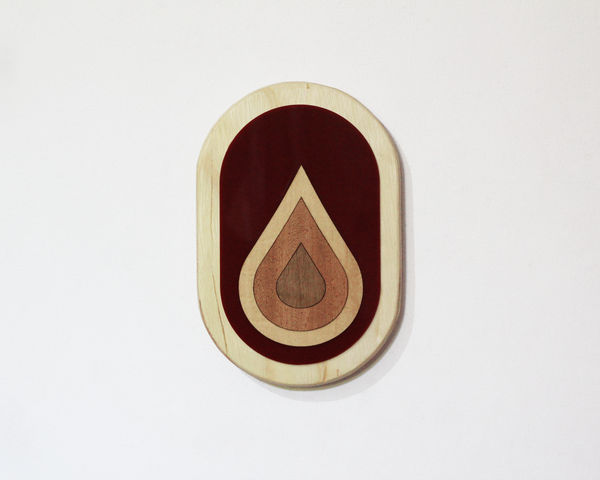
The 'Extrusion' series, made of Anjelim wood (a native Brazilian wood variety) and steel is also represented in this show; exploring distortions and extensions of these materials. The biomorphic forms used here are also inspired by indigenous Brazilian architecture. Similarly, a series of new wall works using marquetry techniques are presented; also inspired by the artist's research into the solar cycles, aurora forms and indigenous architecture. There are five native Brazilian wood types used in these works: Frejô, Marfim, Muiracatiara, Ipê and Cedro. Native Brazilian wood is given an almost reverential place in these works; as a precious natural resource, and as a material in perfect natural balance, with all four vital elements (Air, Water, Earth and Fire) contained with it.
In this moment, when the world often seemingly lacks a visible positive future perspective, we need the vital force of hope - not in a passive or naive sense - to act as a catalyst for change. This year Brazil will host the environmental summit COP-30, which will happen in the Amazon region (Bélem) for the first time, in a moment where intense debate around climate change with the engagement of society as whole is necessary. Narcélio Grud’s activism on a social scale surrounding this issue, is therefore even more welcome and necessary.
He has been the recipient of numerous art awards since 2007, and in recent years has had various major shows in Brazil and internationally, including in 2025 at Kupfer (London) as part of the UK/Brazil Season of Culture 2025-26, supported by the British Council and Instituto Guimarães Rosa; as well as recent solo exhibitions at Museu de la Música Mexicana (DF, Mexico), The Museum of Image and Sound (Fortaleza, Brazil) and the Pinacoteca do Ceará (Fortaleza, Brazil). His work is included in various distinguished Brazilian public collections, including at Museu Niemeyer, Pinacoteca de Fortaleza, the state collections of Rio de Janeiro, Fortaleza, Rio das Ostras and Sobral, as well as the newly-inaugurated Parque das Esculturas (Espirito Santo, Brazil).
I am honoured to present Narcélio Grud’s exceptional work to a UK audience at such a pivotal time in his career and at a time when his work demands a more international presence.
-
 Narcélio Grud, Perspectiva, 2025
 -
Narcélio Grud, Serpentina, 2025
-
Narcélio Grud, Recurvo Continuo (Continuous Recurve), 2025
-
Narcélio Grud, Recurvo 04, 2025


-
Narcélio Grud, Extrusion Qubba , 2025
-
Narcélio Grud, Extrusion Jangovar , 2025
-
Narcélio Grud, Qubba 04, 2025
-
Narcélio Grud, Jangovar 04, 2025